


Crossing the Forth
Last Friday, I caught an early train north, on my way to a brand new literary festival. I drafted my blog, but, sorry pals, I did not get round to posting it. The wifi was not quite up to it. So here it is, this week. Next week, I’ll tell you a bit about the festival itself, because it was terrific fun.

This morning I’m on my way to Aberdeen for Bookause Aberdeen Book Festival, and I’m genuinely delighted to be going. There’s something lovely about being invited to speak about your work. Writing itself happens in such solitude. Most of it is just you and the page, or you and the screen, wrestling with sentences that may or may not behave themselves. Then every so often you get invited into a room with other people who care about books, stories and ideas, and suddenly the thing becomes communal again.
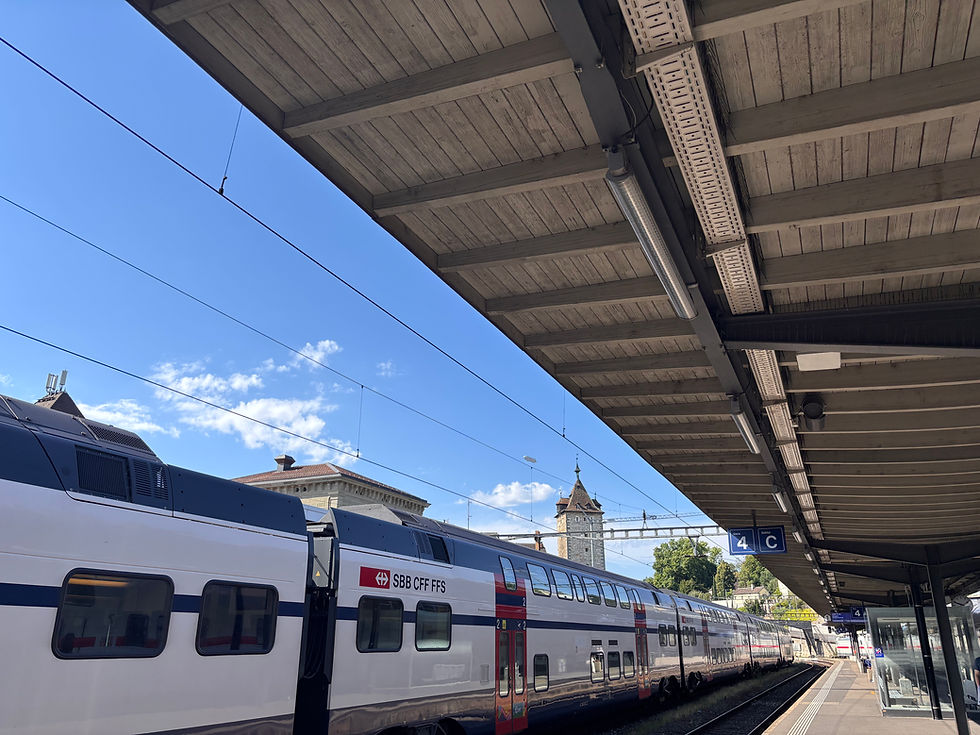
Crossing the Forth this morning, over the mighty rail bridge, which my children call "the sleeping dragon", the water below was choppy enough that I could make out the patterns of the current in the silt. Then the rail line heads east at first. The Burntisland Shows are taking shape on a field, a ferris wheel bright against the houses & wee hill behind. Then fields stretch away on one side, up into rolling hills. The sea appears and disappears on the other, silvery in the distance. Growing up partly in Spain, I find Scottish summers capricious. It’s not steady growing heat, until the land is dusty and parched. Here, the weather changes by the hour, warm sun and magical light, moody haars, drizzle and downpours. Perhaps that's why we celebrate them so enthusiastically, and I think why even now, the feeling that there is more to nature than simple science seems to cling to the land.
Today I'll be talking about mythical creatures in my writing, which sounds wonderfully dramatic when I put it like that. The truth is that mythical creatures appear differently across the different strands of my work. My writing life has settled into three distinct areas over the years, although they often overlap and borrow from one another.
There are the novels, which are probably where most of my creative energy goes. Novel writing asks for a particular kind of commitment. You have to live with a story for a long time. You need to keep showing up for it, even when you are bored of it, stuck in it, or convinced it is terrible. My novels sit broadly in the literary fiction camp, but lately I've found myself allowing a little more magic in through the side door. Not fantasy, I’m not moving there, but a sense that the world might be slightly stranger than it first appears. Characters who believe in things that cannot quite be explained. A touch of animism. Folklore sitting quietly beneath the surface. The possibility that landscape itself might hold meaning.
I think that comes partly from living in Scotland. It is difficult to spend time here without feeling the weight of stories. Every loch, hill and coastline seems to have accumulated layers of myth. Whether you believe those stories literally is almost beside the point. They shape the way we understand place, and my characters live in that.
Then there is poetry. Poetry feels different because I never consciously chose it. I simply started writing poems when I was eleven or twelve and never really stopped. At this point it feels less like a decision and more like a habit of mind. An itch I have to scratch.
The difference now is that I've learnt how much work sits behind the finished poem. When I was younger I thought poems arrived fully formed. Now I know better: I edit, I cut, I abandon things. I keep notebooks full of fragments that never become anything. I read far more poetry than I used to. I've learnt that writing the poem is often only half the job.
The poems in my recent pamphlets have travelled with me through years of life: children growing up, work, grief, and all the ordinary and extraordinary things that happen while you're busy becoming whoever it is you're going to be. The magic and mythical in these are really just the act of growing, transforming into the person you become, the magic of connection.
Then there are my short stories. I have a particular soft spot for short stories and I don't think they get nearly enough attention. They are massively underrated. Some of my earliest encounters with stories that genuinely surprised me happened through short fiction. Roald Dahl first, then later Borges, Cortázar and García Márquez. My school librarian in Spain handed me books that completely rearranged my understanding of what stories could do. Suddenly stories didn't have to behave themselves: reality could shift, strange things could happen (go read Cortazar’s Axolotl – it’s a masterpiece).
When I write short stories, they often drift towards science fiction or contemporary fairy tales. I’m picking at questions rather than trying to provide answers. If I'm honest, I think a lot of them are wrestling with climate anxiety in one form or another. They are trying to make sense of a future that often feels uncertain. Some of them are probably also circling around questions of belief.
I was raised Christian and no longer consider myself religious. That's not a chat for here, but I sometimes think what I miss is not doctrine so much as the feeling of belonging within a shared understanding. Belonging to something bigger than me. Stories seem to have become one way I explore that, with mythical heroes and creatures.
Not because I believe there are kelpies waiting in Scottish lochs or selkies shedding sealskins on remote beaches. But because folklore often gives us ways of talking about things that are otherwise difficult to name. Our relationship with the natural world, our responsibilities to one another, frame our morality, helps us think about loss, love, grief, time. Stories let us approach those questions sideways (sidebar: I did philosophy at school too. I think I’m still mucking around with some of that in my head).
As I've got older, I've become increasingly interested in the places where reality and imagination overlap. Not in escaping the world, but in understanding it more fully. Which brings me, unexpectedly, back to chairs. My mother used to count chairs in church. I've written before about counting chairs at poetry launches. Wondering who will come. Hoping the room will fill. Looking for evidence that people still want to gather together around words. The older I get, the more I think those things might be connected. Church offered community, ritual and a shared search for meaning. Literature offers something different, but perhaps not entirely different. We gather in rooms. We tell stories, listen carefully and try to understand what it means to be human. We’re looking for connection, not certainty, a chance to sit in a room with strangers and discover that someone else has wondered about the same things, been afraid of the same things and loved in the same way.
So today in Aberdeen, I'll talk about mythical creatures and stories and all the strange routes that writing takes through a life. I'll meet readers and writers and people who simply enjoy books. And as the fields slide past on one side of the road and the sea flashes silver on the other, I'm reminded how lucky I am that this writing life occasionally asks me to leave my desk and go somewhere, usually with a coffee in one hand and my laptop in the other.The novels will still be waiting when I get home. The poems will still be muttering away somewhere in the background. The short stories will continue to pop up on me when I'm least expecting them. For today, though, it's enough to be heading north through a Scottish summer, chasing stories.


Comments